Custom embroidered heavyweight hoodies: from artwork to an approved sample
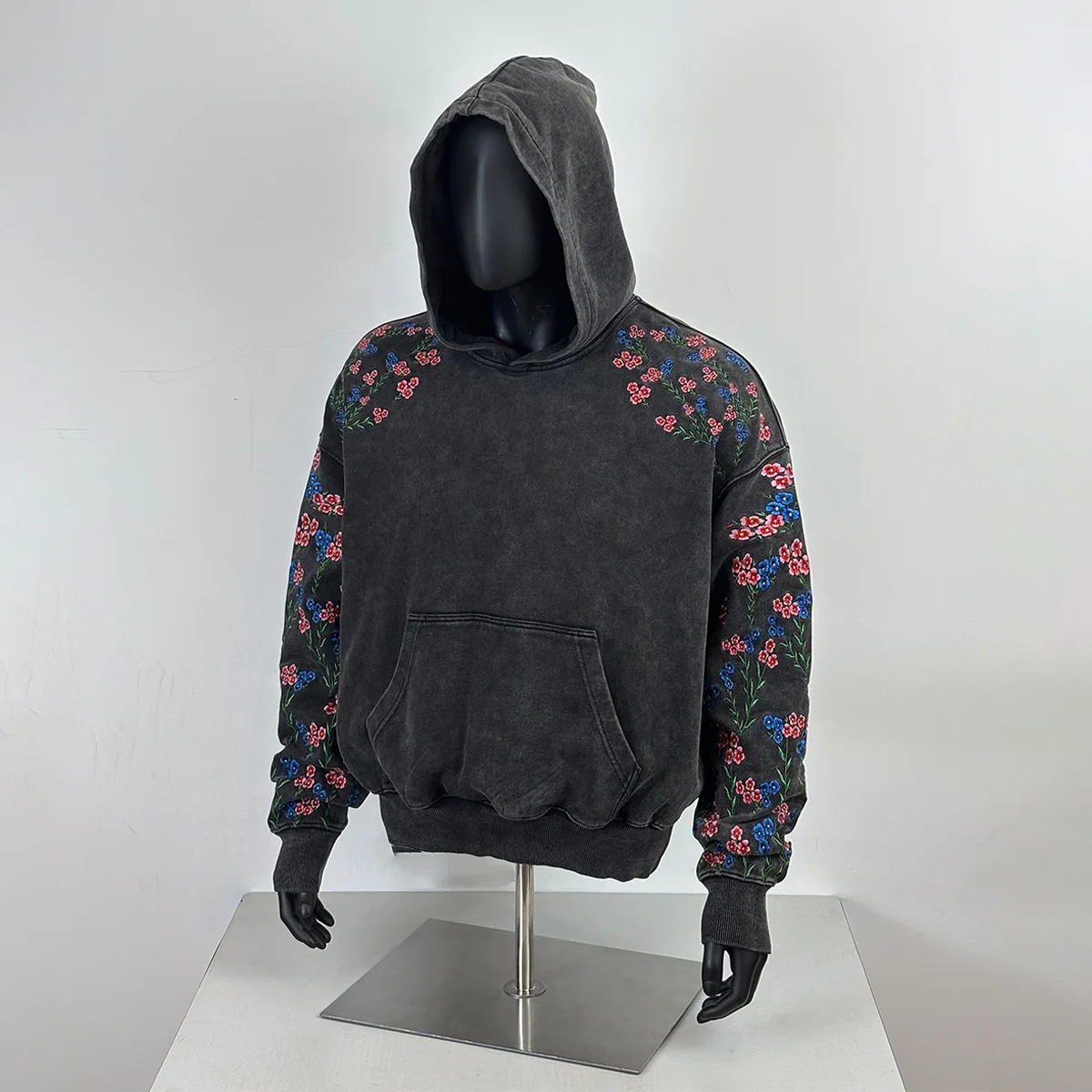
Look at the dark hoodie beside this guide. The flowers read as a band of color from a few steps away. Up close, the effect depends on small spaces between the green stems, red petals and blue blooms. Fill those spaces with extra thread and the sleeve takes on a different look and feel.
On this page
- Key takeaways
- Choose the stitch by the part of the artwork it needs to carry
- Test the backing on the actual hoodie fabric
- Give the digitizer a small detail worth testing
- Place sleeve artwork on a sleeve someone can wear
- Decide when to embroider a washed hoodie
- Compare stitch-count pricing at the same specification
- Buyer FAQ
- Sample your embroidered hoodie
TOPSHOW Floral Sleeve Embroidered Hoodie. The black space between the motifs is part of the artwork.
When you send TOPSHOW a hoodie brief, mark the details your buyer should notice at both distances. Those marks help us choose a stitch technique, prepare a sew-out and identify which decisions need a finished garment.
Key takeaways
- Sample the smallest letter and the largest solid area at finished size. They reveal different problems: a closed letter opening or a panel that feels stiff.
- Approve the front, the trimmed reverse and the washed sample. A clean photograph of the face tells you little about how the backing feels against the wearer.
- For a 100-, 300- or 500-piece quote, keep the fabric, artwork dimensions and placements identical. Request the digitizing fee and recurring decoration cost separately.
Choose the stitch by the part of the artwork it needs to carry
Mark one area that needs sharp edges, one that needs height and any broad area that could be made from a separate fabric. A single crest might use flat lettering, a chenille initial and a stitched border. Show each treatment on its own layer so the quote and sample cover the same design.
| Technique | A good use on a hoodie | What to inspect on the sew-out |
|---|---|---|
| Flat satin or fill embroidery | Use satin for the strokes of a chest wordmark and rows of fill stitches for wider shapes. | Look through the centers of small letters. Bend the widest fill area over your knuckles to feel how much the shell can still flex. |
| 3D puff embroidery | A broad, raised initial with room for stitches to cover the foam. | Look along the side of the raised stroke, especially at open ends and tight corners. Check for exposed foam after the care trial. |
| Chenille | A varsity letter or mascot with a plush, looped surface. | Check whether neighboring loops close the openings in the design. On a separate patch, inspect the perimeter attachment as well as the face. |
| Twill appliqué | A large emblem where a fabric piece can supply the solid color. Choose a covered border or an intentionally raw edge. | Check the border at the tightest curve. After washing, measure the exposed fringe and inspect the retaining stitch underneath. |
| Chain stitch | A drawn line, outline or piece of script with visible linked stitches. | Follow the sharpest turn. Look for breaks in the line and inspect the secured ends on the reverse. |
For a 28 × 28 cm back design, request two trials if the background occupies most of the square. Fill the background with stitches on one and use twill with an embroidered border on the other. Compare both on the wearer with the hood down. Record the machine stitch counts, attachment steps and finished hand before choosing which version to cost.
Test the backing on the actual hoodie fabric
A 450 GSM shell can still stretch across the chest. Request a loopback French terry and a brushed fleece in the weight range you are considering, then identify which face will carry the embroidery. Brushing on the inside of a sweatshirt does not tell you how much texture the needle will encounter on the outside. Compare terry and fleece for hoodie sampling.
Start a dense design on stretchy knit with a cutaway backing trial. Release the cloth from the hoop, allow it to relax, and inspect it under light from the side. A ridge that appears only after release is easy to miss on the machine. If fine strokes sink into a raised face, try a removable topping on the front while keeping the backing and stitch file the same. Madeira’s backing and topping guide.
Turn the sample inside out. Run a finger over the backing edge, thread ends and any overlap where the design changes direction. If a chest logo feels scratchy, identify the exact spot before specifying a comfort cover. Wash the covered trial once under the intended care instructions and inspect its edges again.
Give the digitizer a small detail worth testing
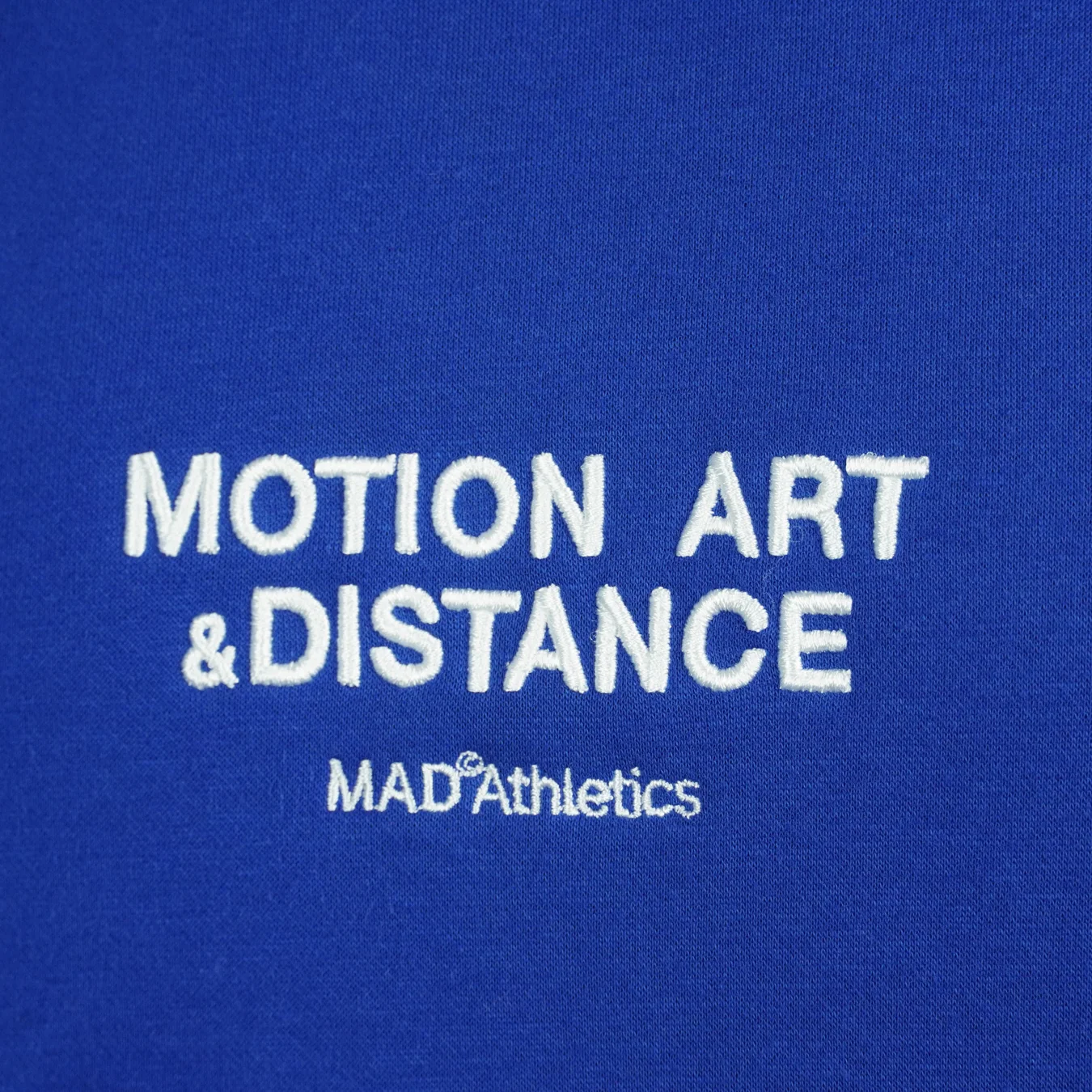
Send editable vector artwork, a dimensioned PDF and a thread reference for each color. Write the finished width in centimeters. A digitizer uses that size, the fabric and the desired stitch direction to plan the machine file. If your original logo includes a fine tagline, send a second drawing with the tagline enlarged. Ask for the two versions side by side on one strip.
For a first trial, try a 5 mm letter in flat satin or a 4 mm-wide stroke in a block puff initial. These are test dimensions. The letter shape, thread, needle and ground can change which detail survives. Approve the smallest opening you can actually read after washing. For a multicolor design, check physical thread cards beside the approved body shade under the same light.
Place sleeve artwork on a sleeve someone can wear
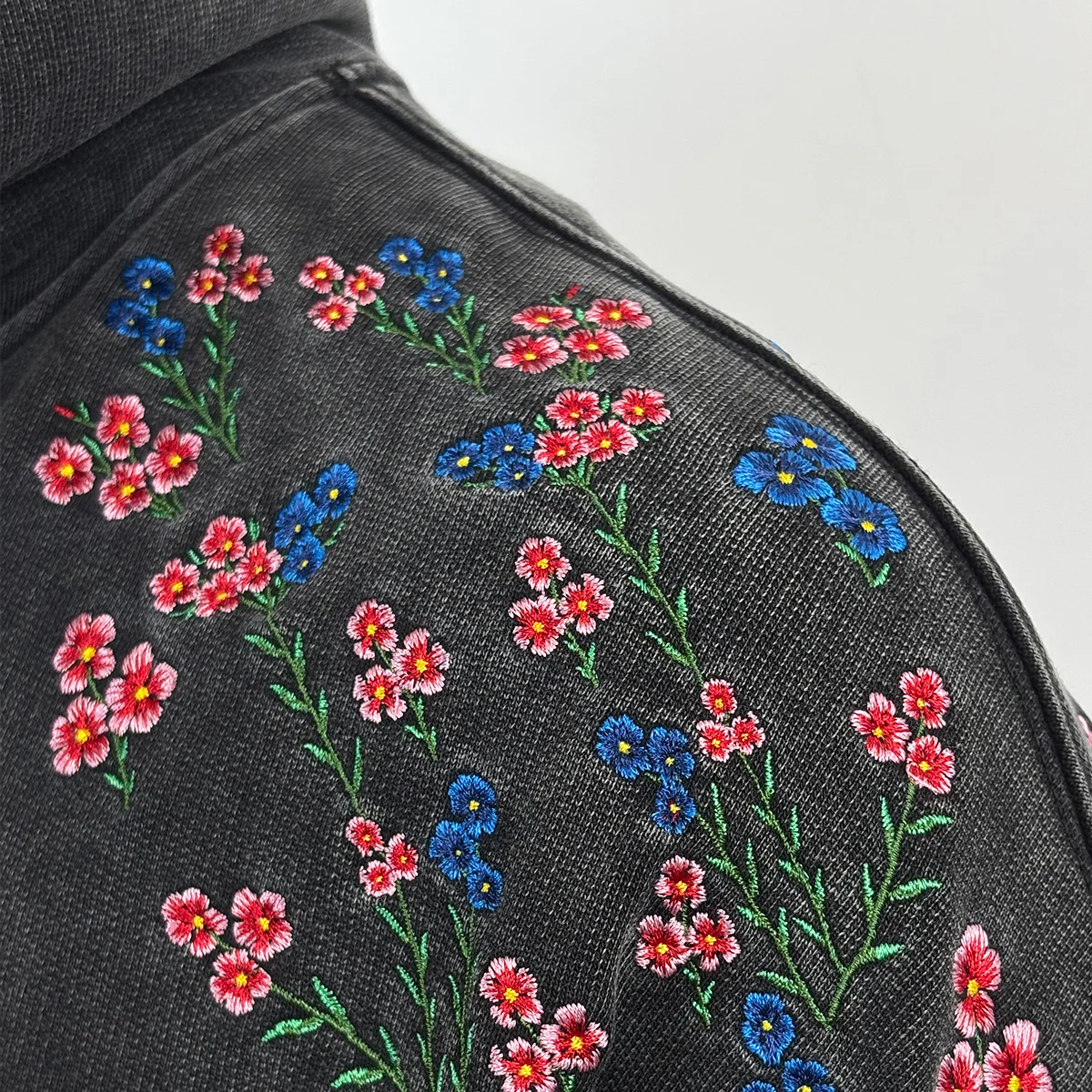
Lay the paper artwork on the flat pattern and mark the shoulder seam, sleeve center and cuff end. Then photograph the sewn sleeve with the arm at rest and bent. A flower that faces forward on a table may turn toward the back of the arm when worn. Identify which motif the buyer should see from the front, and repeat the check on the smallest planned size.
For a left-chest logo, record the wearer’s side and measure from two named landmarks. For a zip-up, draw the actual opening into the artwork. Close the zipper on the finished sample, follow one line across the gap and move the slider past the nearest embroidery. Keep the approved clearance with the placement drawing. See the cross-zip embroidery guide or compare full-zip and quarter-zip constructions.
Decide when to embroider a washed hoodie
| Intended finish | Sequence to trial | Approval decision |
|---|---|---|
| Clean lettering on a faded base | Finish the ground first, then embroider. Confirm hoop access at the chosen placement. | Compare thread contrast on the light and dark ends of the approved body shade range. |
| Worn fabric edge around an emblem | Attach the appliqué on a flat panel, assemble the hoodie and run the proposed wash. | Sign off the fringe width and check that the retaining seam is still secure. |
| Raised puff or looped chenille | Trial decoration after a demanding garment finish. Test the completed garment under its intended care cycle. | Compare height, exposed foam, flattened loops and border attachment with the retained control. |
When briefing patchwork, show whether a colored area replaces part of the shell or sits on top of it. A cut-and-sew panel changes the pattern and introduces a seam. An appliqué leaves the shell underneath and adds a second layer. At an elbow or across the back, bend the completed sample to judge the bulk where the layers meet. Approve a washed hoodie shade band.
Compare stitch-count pricing at the same specification
The minimum for this brief is 100 pieces per style and colorway, with mixed S–XL sizes. For example, a single black colorway could contain 15 S, 35 M, 35 L and 15 XL. Give each additional colorway its own quantity line and identify thread changes separately.
For comparable 100-, 300- and 500-piece quotes, hold the body, finished GSM, wash, artwork width, placement count and packing constant. Request the digitizing and sew-out charges separately from the per-piece decoration cost. A crest on the chest and a small logo on the cuff are two placements; even a short cuff logo may require its own setup. For chenille or appliqué, ask for patch making and attachment to be itemized. Specify the named port for a FOB quote.
Build the approval dates around three physical items: the stitched swatch, the assembled garment and the finished wash trial. Record which version the bulk quote covers, any sample-credit terms and the owner of the next approval. A later change to the width of a logo can change both the stitch file and its price.
Buyer FAQ
What should I approve on a sew-out before requesting the full sample?
Approve the artwork dimensions, legibility, thread references and the feel of the face and reverse on the intended shell. Reserve placement, fit and access to pockets or zippers for the assembled sample.
Can one file work across every hoodie size?
It can when the artwork width stays fixed and there is sufficient space on each size. Check the smallest chest or sleeve first. If the artwork changes size, review a new sew-out at the revised dimensions.
Can we combine embroidery and puff printing?
Show both placements on one garment drawing. A small chest embroidery and a back puff print can be evaluated separately on swatches. Approve the assembled hoodie after all heat and wash steps, with the hood resting over the back graphic.
How can we soften an oversized embroidered back?
Ask for a trial that replaces one broad fill area with appliqué or exposed body fabric. Keep the outline dimensions the same, then compare stiffness, reverse-side comfort and cost with the original.
Sample your embroidered hoodie
Send TOPSHOW the artwork at its finished size, a placement drawing, your fabric or wash reference and quantities by color. Circle the smallest detail that must remain readable.